
Introduction: The Universe’s Great Cosmic Mystery
For centuries, astronomy has relied on the simple principle that what we observe through powerful telescopes—the light emitted by stars, galaxies, and nebulae—constitutes the entirety of the cosmos. This visible matter, composed of protons, neutrons, and electrons, forms the planets, the dazzling galaxies, and even the dust clouds that fill interstellar space. However, in the 20th century, meticulous astronomical observations began to reveal a profound and unsettling inconsistency: the gravitational forces necessary to explain the movement of galaxies and galaxy clusters far exceeded the forces that could be accounted for by all the detectable, luminous matter. It became startlingly clear that the universe was governed by a massive, unseen influence, a mysterious gravitational scaffold that dictates the structure and motion of everything we can see.
This discrepancy led to the revolutionary concept of Dark Matter, an invisible, non-luminous substance that cannot be seen, touched, or directly detected because it does not interact with the electromagnetic spectrum—it neither emits nor absorbs light. Current cosmological models now overwhelmingly suggest that the visible matter that makes up every star and every human being accounts for less than five percent of the universe’s total mass-energy content. The remaining ninety-five percent is composed of roughly 68% Dark Energy, responsible for accelerating cosmic expansion, and about 27% Dark Matter, the invisible glue holding galaxies together.
The existence of Dark Matter is not speculative fantasy; it is a hypothesis necessitated by an overwhelming body of observational evidence concerning cosmic structure, galaxy rotation, and gravitational lensing. This invisible constituent represents one of the most significant unsolved puzzles in modern physics and cosmology. The global scientific community is engaged in a monumental quest—a multi-faceted endeavor spanning deep underground laboratories and orbital telescopes—to finally capture, identify, and understand this elusive substance that governs the gravitational destiny of the universe. This exploration will delve into the compelling evidence for Dark Matter’s existence, the leading theories regarding its identity, and the cutting-edge experiments striving to bring this invisible mass into the light.
Section 1: The Compelling Evidence for Dark Matter
The hypothesis of Dark Matter is not based on assumption but on concrete, irrefutable observational evidence demonstrating a gravitational imbalance in the cosmos.
A. Galactic Rotation Curves
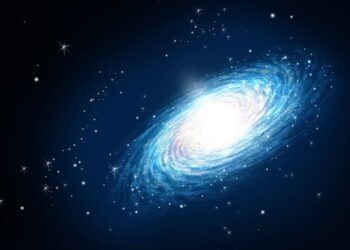
The first and most powerful piece of evidence for Dark Matter came from studying how galaxies spin.
A. The Expected Rotation: Based on the visible mass (stars and gas) in a galaxy, classical physics predicts that stars near the center should orbit quickly, and stars farther out should orbit much slower, similar to how planets orbit the Sun in our solar system.
B. The Observed Anomaly: Astronomer Vera Rubin observed that stars located near the outer edges of spiral galaxies were orbiting just as quickly, or even faster, than stars nearer the core. This implied that there must be massive, unseen mass exerting an enormous gravitational pull on the outer stars.
C. The Halo Hypothesis: This unseen mass cannot be concentrated only in the center. Scientists conclude that galaxies are embedded within a vast, spherical, invisible Dark Matter Halo that extends far beyond the visible spiral arms, providing the necessary extra gravitational force.
B. Gravitational Lensing
One of the most dramatic pieces of evidence relies on the distortion of light, confirming that Dark Matter has mass and interacts gravitationally.
A. Einstein’s Prediction: Einstein’s theory of General Relativity states that mass warps the fabric of spacetime, and this warping causes light to bend as it passes nearby. Massive objects, visible or invisible, act like a lens.
B. Observing Distortion: Astronomers observe light from distant galaxies being severely magnified, stretched, and distorted as it passes through galaxy clusters. The degree of this gravitational lensing is far too strong to be explained by the visible mass of the clusters alone.
C. Mass Mapping: By measuring the precise distortion of light, scientists can map the total mass distribution in a cluster. This mapping consistently shows that the majority of the mass required to create the lens effect is invisible, lying in regions where no stars or gas exist.
C. The Bullet Cluster
The Bullet Cluster provides arguably the most direct visual evidence separating the normal, visible matter from the dark, invisible matter.
A. Colliding Clusters: The Bullet Cluster is the result of two massive galaxy clusters colliding at incredibly high speed. This collision provides a unique laboratory for studying the two types of matter.
B. Separation of Components: The normal, visible matter (hot gas) interacts electromagnetically, creating drag and friction. This gas component was observed slowing down and glowing brightly in X-rays, forming a central “bullet” shape.
C. Dark Matter Trailing: However, the gravitational maps (derived from lensing) showed that the majority of the mass—the Dark Matter—passed right through the collision without slowing down or interacting. This confirms that Dark Matter is non-baryonic (not made of protons and neutrons) and weakly interacting, passing through normal matter like ghosts.
Section 3: The Search for Dark Matter’s Identity
Scientists know what Dark Matter is not (it’s not normal matter), but its true identity remains the central mystery. The candidates fall into two main categories: Cold Dark Matter and Warm/Fuzzy Dark Matter.
A. Ruling Out Baryonic Candidates (MACHOs)
Before proposing exotic particles, scientists considered if Dark Matter could simply be made up of non-luminous normal matter (Baryonic Matter).
A. Failed Candidates: Possibilities included black holes, brown dwarfs (failed stars), or planets floating in the dark. Collectively, these were called Massive Compact Halo Objects (MACHOs).
B. Microlensing Surveys: Extensive surveys were conducted to detect the gravitational signature of MACHOs as they briefly bent the light of background stars (microlensing).
C. Insufficient Number: These surveys found an insufficient number of MACHOs to account for the necessary missing mass. Furthermore, Big Bang Nucleosynthesis models limit the total amount of baryonic matter the universe could have produced.
B. The Leading Candidate: WIMPs (Cold Dark Matter)
The prevailing theory suggests Dark Matter is composed of an entirely new, exotic type of subatomic particle that moves slowly and interacts only through gravity and the weak nuclear force.
A. Weakly Interacting Massive Particles (WIMPs): These hypothesized particles are thought to be relatively heavy (massive) and interact so infrequently with normal matter that they have evaded detection.
B. Slow Movement (Cold): WIMPs are categorized as Cold Dark Matter (CDM) because they move much slower than the speed of light. This slow speed is critical, as it allows gravity to pull them into the small, dense clumps necessary to seed the formation of large galactic structures.
C. Supersymmetry Connection: The existence of WIMPs is naturally predicted by certain extensions of the Standard Model of Particle Physics, such as Supersymmetry (SUSY), which proposes a heavier “superpartner” for every known Standard Model particle.
C. Alternative Candidates
While WIMPs are the primary focus, other candidates address specific theoretical issues or offer unique detection signatures.
A. Axions: These are extremely light particles (much lighter than WIMPs) that were originally theorized to solve a different problem in particle physics (the strong CP problem). Axions are highly sought after because they could convert into detectable photons in the presence of strong magnetic fields.
B. Sterile Neutrinos: Neutrinos are known to be light and weakly interacting. Sterile Neutrinos are heavier, even more weakly interacting versions that may only interact through gravity, fitting some Dark Matter requirements.
C. Fuzzy Dark Matter: This model posits extremely light particles that behave more like a quantum wave than a classical particle, potentially solving the observed small-scale structure problems of the WIMP model.
Section 4: The Global Detection Hunt
The quest to directly detect Dark Matter involves three distinct and complementary experimental approaches conducted in some of the most protected environments on Earth.
A. Direct Detection Experiments (Underground)
These experiments aim to observe the incredibly rare instance when a WIMP directly collides with the nucleus of an atom in a controlled laboratory setting.
A. Shielding: These detectors are located deep underground (in mines or tunnels) to shield them from cosmic rays and other forms of background radiation that could mimic a WIMP signal.
B. Detection Principle: Massive, ultra-cold target materials (like Xenon or Germanium) are used. The hope is that a passing WIMP will strike an atomic nucleus, causing it to recoil and produce a tiny flash of light or a subtle ionization signal that can be recorded.
C. Leading Experiments: Projects like LUX-ZEPLIN (LZ) in the United States and XENONnT in Italy use liquid Xenon detectors to search for these minute WIMP-nucleus interactions, pushing the sensitivity boundaries of physics.
B. Indirect Detection Experiments (Space and Earth)
These experiments search for the annihilation or decay products that would be emitted if Dark Matter particles were to collide with each other in high-density areas of the cosmos.
A. Annihilation Products: If Dark Matter particles (like WIMPs) collide, they are theorized to annihilate into Standard Model particles, such as high-energy gamma rays or antimatter (positrons or antiprotons).
B. Target Locations: Scientists focus telescopes and detectors on areas where Dark Matter concentration is highest, such as the center of our Milky Way galaxy or the halos of dwarf galaxies.
C. Orbital Telescopes: The Fermi Gamma-ray Space Telescope and the Alpha Magnetic Spectrometer (AMS-02) on the International Space Station search for these subtle excess signals of gamma rays and antimatter coming from space.
C. Collider Experiments (The LHC)
Particle accelerators, like the Large Hadron Collider (LHC) at CERN, attempt to create Dark Matter particles in high-energy collisions, essentially reversing the annihilation process.
A. Creating the Unknown: By smashing protons together at near the speed of light, the LHC generates energies similar to those present in the early universe. Scientists hope these conditions are sufficient to spontaneously generate a WIMP or other exotic Dark Matter particle.
B. Missing Energy Signature: Since WIMPs would not interact with the detectors, their presence would only be known indirectly. Scientists look for a significant amount of missing energy and momentum that escapes the detector, which would be the signature of an invisible particle flying away.
C. Proving the Mechanism: Successful creation of a Dark Matter candidate at the LHC would confirm the existence of the particle and provide crucial data on its mass and interaction strength.
Section 5: The Cosmological Implications
The study of Dark Matter is not just about identifying a particle; it fundamentally changes our understanding of the universe’s evolution and ultimate fate.
The Role in Structure Formation
Dark Matter was essential for the universe to evolve from a nearly homogeneous plasma into the clumpy structure of galaxies and clusters we see today.
A. Gravitational Seeds: Immediately after the Big Bang, the distribution of normal matter was too uniform and too energetic to rapidly collapse under its own gravity.
B. The Scaffold: Dark Matter, which only interacts gravitationally and does not interact with radiation, was able to begin clumping much earlier. These early, dense clumps acted as the gravitational seeds or scaffolds.
C. Attracting Baryonic Matter: Normal baryonic matter was later pulled into these pre-existing Dark Matter structures, forming the first stars and galaxies along the lines of the massive, invisible Dark Matter web.
The Ultimate Fate of the Universe
The amount and nature of Dark Matter profoundly influences the long-term gravitational behavior of the cosmos, although Dark Energy is the dominant factor in expansion.
A. Deceleration: If Dark Matter were the sole dominant force, its gravity might be strong enough to eventually overcome the outward push of Dark Energy, causing the expansion to slow down or even reverse (The Big Crunch).
B. Cosmic Web Dynamics: Dark Matter defines the large-scale structure of the universe, forming vast filamentary structures known as the Cosmic Web, along which galaxy clusters are distributed.
C. Precision Cosmology: Measuring the properties of Dark Matter is essential for completing the Standard Model of Cosmology ($\Lambda$CDM), allowing scientists to model the history and predict the future evolution of the universe with high precision.
Conclusion: The Horizon of Discovery

Dark Matter remains one of the universe’s most profound and stubborn riddles, representing a staggering 27% of all mass-energy that has perpetually eluded direct identification. Its existence is not a theoretical flight of fancy, but a fundamental necessity dictated by meticulous observations of galactic motion and gravitational lensing.
The invisible gravitational pull of Dark Matter is what keeps galaxies spinning faster than their visible matter alone can account for.
Irrefutable evidence from phenomena like the Bullet Cluster demonstrates that this invisible mass interacts only through gravity, separating it from all normal matter.
The scientific community’s leading candidate for Dark Matter’s identity is the Weakly Interacting Massive Particle (WIMP), an exotic new particle predicted by extensions to the Standard Model of physics.
The hunt is global and multi-pronged, involving deep underground labs searching for particle recoil and space telescopes seeking annihilation products.
Understanding Dark Matter is vital because its gravitational influence formed the initial cosmic scaffold upon which all visible galaxies and structures were built.
Ultimately, solving the Dark Matter puzzle will not only validate our physical laws but will complete the map of our universe and reveal the true nature of its primary constituents.